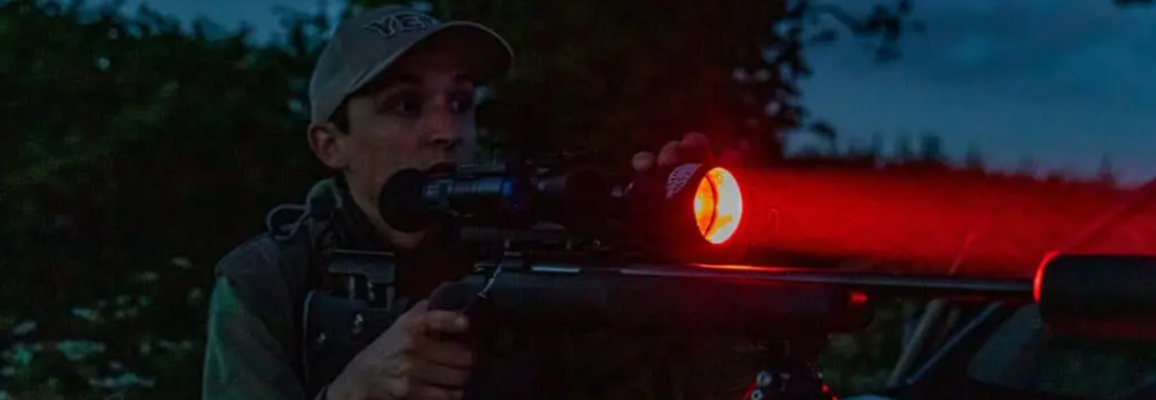
When shooting at night, the following golden rules apply:
- You must ensure that you have established safe lines of fire with backstops and that these are used.
- You must clearly identify the quarry you are about to shoot. Never shoot if you can only see a pair of eyes.
- Always use the appropriate firearm, shotgun, or air weapon for the quarry species.
- It is your responsibility to ensure that you abide by the law.
- Have respect for the countryside, consideration for others, and due regard to health and safety.

Before night shooting commences remember:
- Permission from the relevant landowner/farmer must be sought before night shooting commences.
- Where applicable, use only the appropriate firearms and ammunition in accordance with the conditions of your firearms certificate.
- Familiarise yourself with all legal requirements.
- It is advisable to carry your relevant air weapon (Scotland), firearm or shotgun certificate, or evidence of it, together with your written permission.
- As a matter of courtesy, you may wish to inform local residents who you are and where you will be shooting, together with your approximate starting and finishing times. You may wish to extend this courtesy to the local police, but you are under no obligation to notify them of any night shooting expedition.
- During daylight hours, familiarise yourself with the terrain over which you are going to shoot. It is harder to judge distances at night. You must ensure that you have established safe lines of fire and backstops.
- Always carry a mobile phone for emergency purposes. Mobile applications for location identification such as ‘What3Words’ or ‘OSmaps’ are also recommended.
In addition, before a shot is taken remember:
- You must clearly identify the body of the animal. Never shoot at a pair of eyes or (if you’re using a thermal imaging device) an unidentifiable heat signature.
- Always ensure there is a safe backstop and a clear field of fire; never shoot towards the crest of a hill.
- Rifle bullets, shotgun pellets and air rifle pellets can ricochet off bushes, fence wire and other obstacles on their way to the target. A telescopic sight, night vision or thermal imaging device may not always reveal these. Always ensure that your line of fire is free from obstacles.
- Any firearm fitted with a telescopic sight, night vision or thermal imaging device must never be used for scanning or searching for quarry.
- Remember that light from a spot lamp or night vision equipment can be reflected from several sources such as vehicle reflectors, glass bottles or binoculars. Binoculars may appear as ‘a pair of eyes’ – particularly when reflecting red filtered light.
- Pay particular attention when shooting close to field boundaries, especially those adjoining roads, tracks, bridleways, and public rights of way.
- Never split a shooting party into groups. Only one shooting party must be out on the ground at any one time. Consider the possibility that other people – whether authorised or not – may be present in the area.
- When using night vision and thermal imaging equipment, the same procedures and considerations which apply to lamping are equally applicable.
- Wounded quarry must be followed up, collected, and dispatched quickly and humanely.

Shooting from a vehicle
- A safety procedure must be explicitly agreed between all participants before shooting commences. Ensure your procedure eliminates the possibility of people entering the field of fire unexpectedly.
- Night shooting can involve multiple people, i.e. a driver, someone who is shooting, and a lamp operator. Anyone not engaged in a dedicated task (i.e., operating the lamp or thermal imaging equipment) must be either inside the vehicle or positioned behind the person shooting.
- Two people should not be shooting at the same time. When two people are planning to shoot, only one firearm should be used at any one time and the other kept unloaded in a gunslip or case and stored securely. A safe method of operating must be agreed, understood, and adhered to by all those participating.
- Ensure that the driver knows the terrain and avoids sharp braking, sudden turning and remains vigilant for potential hazards such as ruts, potholes, and farm implements.
- When shooting from the back of a vehicle, a firm, stable and safe position is required before taking a shot.
- A sandbag, a roll of hessian or a bipod fitted to a rifle will provide a safe and stable platform for taking a shot.
- If shooting from an adapted seat or cradle, it must be firmly secured to the body of the vehicle.
- Never shoot from a moving vehicle.
Personal equipment
-
Always wear appropriate, comfortable clothing and stout footwear to ensure a good grip and traction when taking up a firing position.
-
Always wear ear defenders when using shotguns and un-moderated rifles.
-
A first aid kit should be carried in the vehicle.
For further guidance on the use firearms at night and the related laws please visit the BASC website.
Comments
Loading comments…
Post a comment
to post a comment.